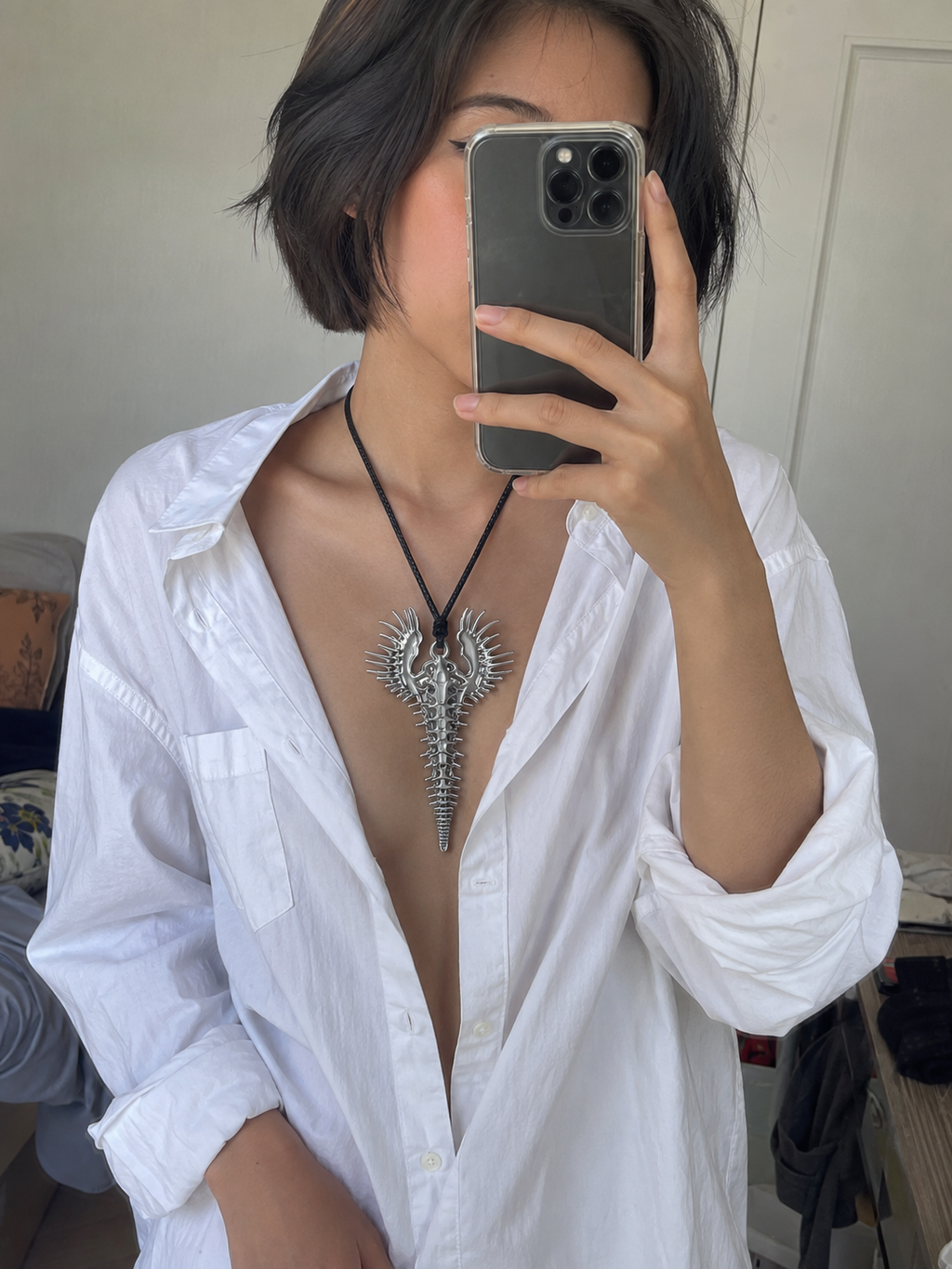
Venus Spine, Worn.
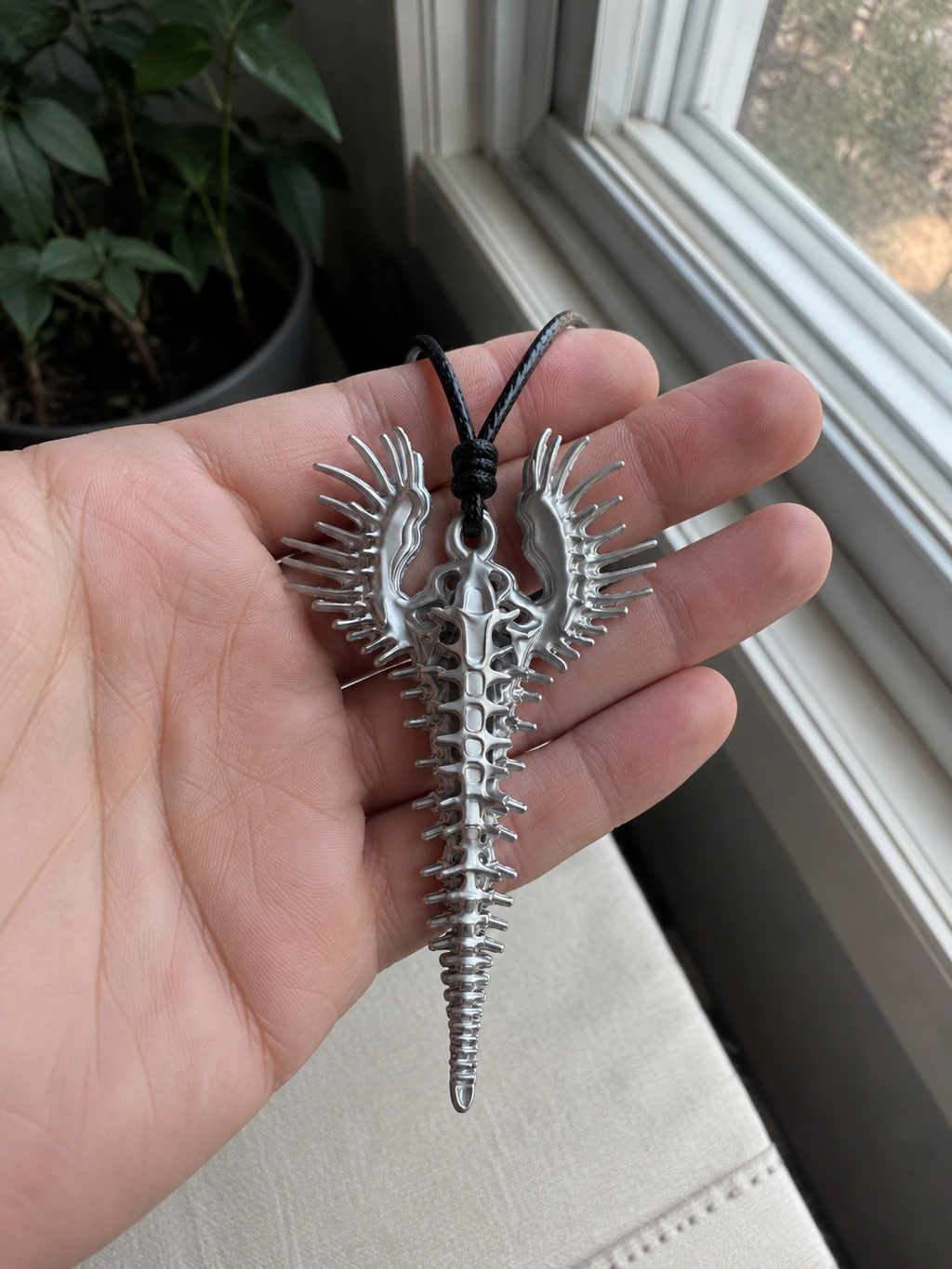
Cast at wearable scale, the pendant carries its full anatomy—trap, spine and tapered terminal—against the body. Bilateral symmetry holds along the central axis, while the black cord suspends the structure from its cranial loop.


Hybridxlab Venus Spine Hand-Cast Venus Flytrap Necklace Botanical Jewelry for Alternative Fashion

Venus Spine
A hand-cast botanical necklace crossing the hinged trap structure of the Venus flytrap, Dionaea muscipula, with vertebral morphology. A sequence of polished metal segments extends from the trap like an exposed spinal axis, forming the remains of an imagined carnivorous organism.
The name joins Venus, inherited from the plant’s common name and its association with attraction, with Spine, an internal structure of support and protection. Together, Venus Spine imagines an evolutionary remnant: evidence of a species that has adapted beyond its familiar botanical form.
Worn close to the body, the piece becomes part pendant, part recovered anatomy. Its mirror-polished surface creates a precise but unfamiliar presence, designed for alternative fashion, creative performances, fashion events and experimental everyday styling.
Each necklace is documented within the Hybridxlab archive and issued with its own Species File.
Details:
• Product Name: Venus Spine
• Archive Code: MS-001
• Form: Cord necklace / wearable pendant
• Wearing: Cord necklace
• Material: Coated metal alloy
• Finish: Mirror-polished silver-tone surface
• Biological Source: Dionaea muscipula / Venus flytrap
• Hybrid Element: Hinged carnivorous trap × vertebral morphology
• Included: Numbered pendant and corresponding Species File
Named from the Venus flytrap and the vertebral spine, Venus Spine imagines an evolutionary remnant—evidence of a species continuing beyond its original botanical form.

Cast at wearable scale, the pendant carries its full anatomy—trap, spine and tapered terminal—against the body. Bilateral symmetry holds along the central axis, while the black cord suspends the structure from its cranial loop.


SPECIES FILE
SPECIMEN MAINTENANCE
Sterling silver darkens with neglect. Treat it as a specimen, not as costume.
Wipe both sides with the anti-tarnish cloth after wear.
Keep away from perfume, sulfur springs, chlorinated pools, and household bleach.
Do not over-polish the darkened interior; the oxidation is part of the specimen.
Return both pieces to the bone-white sleeve. The anti-tarnish strip stays active for approximately six months.
SUPPORT ARCHIVE
Clear answers about orders, shipping, returns, and product support.
The Spine Flytrap Specimen Necklace is a hand-cast botanical pendant inspired by the Venus flytrap and crossed with a vertebral form. It belongs to the Hybridxlab X-Hybrid archive.
This piece draws from the hinged trap structure of the Venus flytrap and the rhythm of a spine. It explores protection, instinct, and controlled tension.
No. Each piece is hand-cast, so slight variations in texture, edge detail, and finish may appear. These are natural marks of the making process.